

ReadyMynd
Know Your Digital Readiness Before Deciding What Comes Next
Software-enabled assessment and analyst-led interpretation for Bangladesh textile and apparel manufacturers.
Start hereSlide 1 of 8
Data Carriers Explained: QR, RFID and NFC on a Garment
A passport is only useful if the information can be reached from the product itself. QR codes, RFID tags and NFC each carry different payloads, survive factory conditions differently and sit at very different price points.
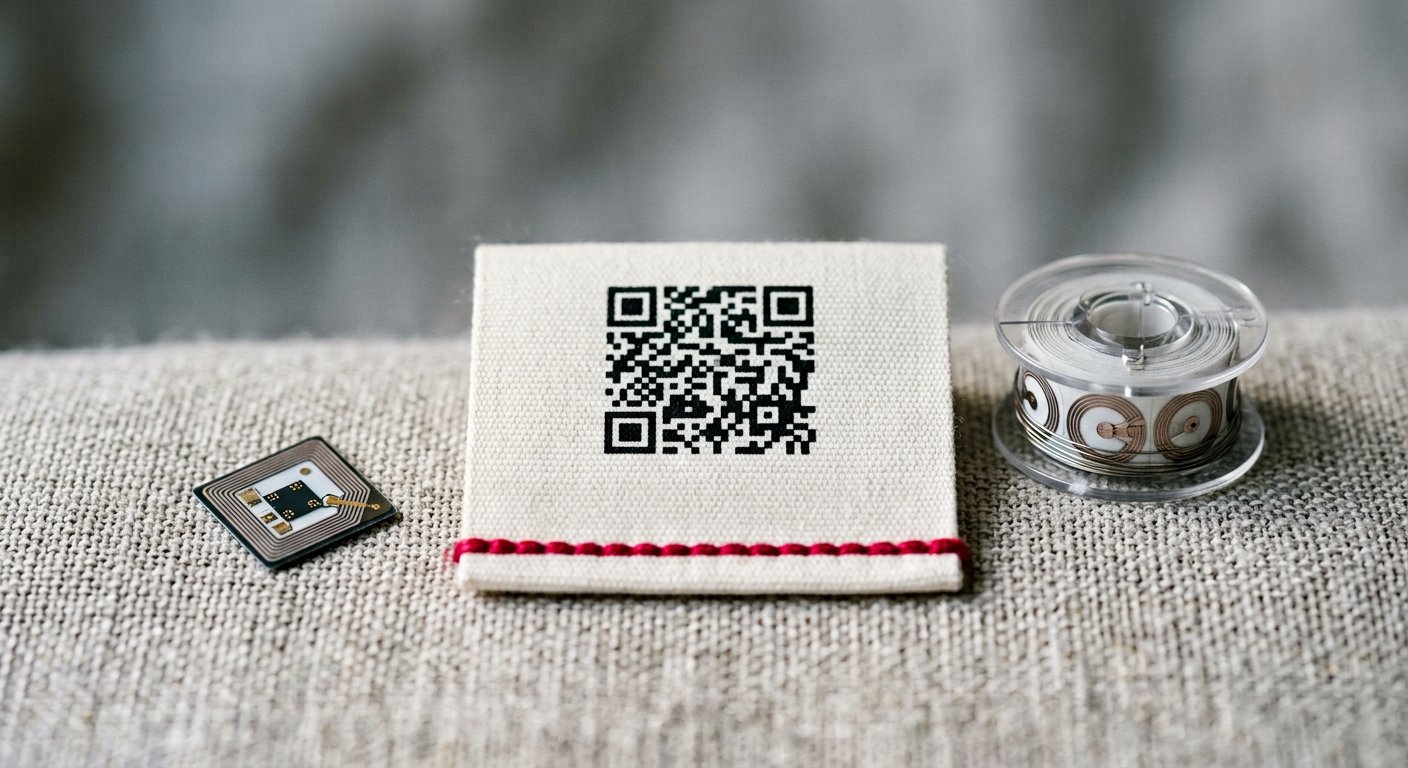
Every digital product passport conversation eventually arrives at a physical question: what is actually on the garment? The regulation describes what information must be accessible, but the mechanism that links a physical item to a digital record is a separate engineering decision — and one factories are increasingly being asked to have a view on.
The first thing to be clear about is that none of these technologies holds the passport. A QR code is a pointer, not a container. It encodes a link, and the link resolves to a record that lives somewhere else. This matters because the hard part is never printing the code — it is maintaining the record behind it, for every style, for as long as anyone might scan it.
A printed QR code costs almost nothing, works with any smartphone camera and survives normal laundering if it is specified properly. Its weaknesses are equally plain: it must be visible to be read, it can be damaged, and it is trivially copied onto a counterfeit. For a single garment scanned at point of sale or by a consumer, these trade-offs are usually acceptable.
RFID carries an identifier that a reader can pick up without line of sight, which is why it dominates in warehouse and inventory handling rather than on the shop floor. It costs more per unit, requires readers at every point where the tag is expected to be read, and introduces a decision about whether the tag stays on the garment after sale. NFC is a near-field variant with a shorter range and better resistance to casual interception, and it is the technology most consumer phones can already read.
The practical advice is unglamorous: choose the carrier based on where the scan actually happens and who does it, not on which technology is newest. A factory shipping to several brands will in any case be told what to apply. What is worth deciding now is not the carrier but whether the record it points at exists, is complete, and can be maintained per style — because a code that resolves to an empty page is worse than no code at all.
Key takeaways
- A data carrier holds a reference, not the passport itself.
- QR is cheapest and most compatible; RFID suits high-volume handling.
- Choose based on where the scan happens, not on novelty.
- A code that resolves to nothing is worse than no code.
DPP Standards & Technical Infrastructure
Better Data Before Bigger Technology
New platforms are often bought to solve problems that are actually data problems. This piece sets out why an evidence-based diagnostic should precede system selection, and how to tell the two apart.
DPP Standards & Technical Infrastructure
Product Identity: Getting Item Coding Right Before Passports Arrive
A passport is attached to a product, and a product has to be identifiable. Style, colour and size codes that work for production often do not survive contact with a buyer’s data request.
EU Regulations & Policy Developments
What the ESPR Framework Means for Bangladesh Suppliers
Regulation (EU) 2024/1781 establishes the framework for Digital Product Passports, with textiles among the priority product groups. Legal responsibility may sit with the operator placing a product on the EU market — but the information itself sits with manufacturers. We explain where that leaves Bangladesh suppliers during the preparation window.
Move From Reading to Knowing.
A Textile DPP Digital Readiness Assessment turns the questions in this article into specific, evidenced answers about your own factory.